
Most enterprises don't suffer from a shortage of tools. They suffer from a shortage of agreement. Every team holds a different mental model of how the system works, and each dashboard tells a slightly different story. The result is a patchwork — accurate in places, contradictory in others, and impossible to trust as a whole.
Start from what already exists
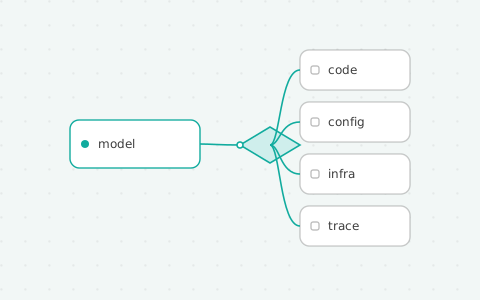
A unified view doesn't come from another layer of documentation. It comes from the system itself: the code, configuration, infrastructure and runtime traces that already define how everything behaves. When your model is derived from these sources rather than described by hand, it can't drift out of date — and it can't disagree with reality.
An answer you can trace is an answer you can trust.
This is the difference between observation and understanding. Observation tells you what happened. Understanding tells you why — and lets you follow any answer back to the exact source that produced it.
Make it legible to everyone
Unification only matters if people can read it. The same model should answer an architect's question about dependencies, a developer's question about data flow, and a stakeholder's question about risk — each in the language they think in. One source of truth, many points of view.
Where to begin
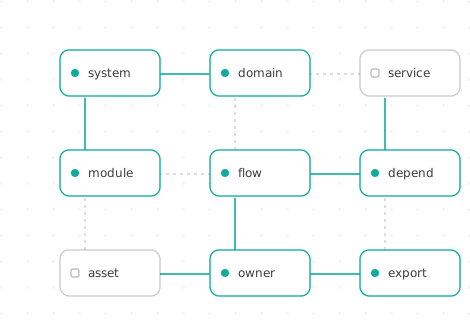
You don't need a rebuild. Start by pointing a deterministic model at a single domain, prove the traceability, then expand. Each step compounds: every component you map makes the next one easier to understand.